
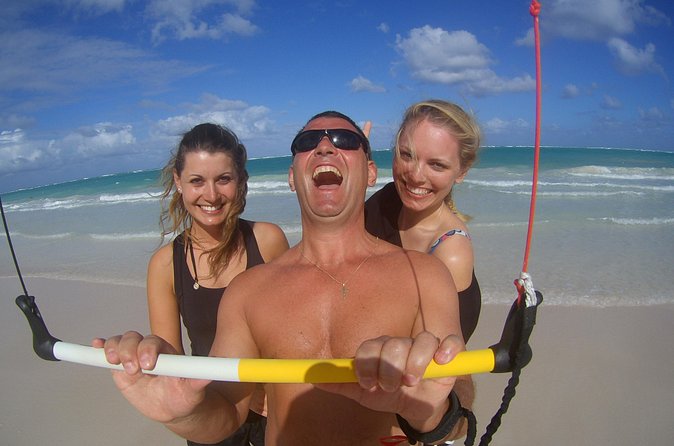
Reviewed · WORKSHOPS
Kiteboarding Lessons in Punta Cana
Kiteboarding in Punta Cana turns your beach day into a real skill-building mission. This course keeps it manageable with small-group coaching (max four) and daily 3-hour lessons that match your level. You get real instruction, not just a hand-wavy demo.
What I like most is the clear step-by-step progression, from trainer kite control toward real riding skills. I also like how instruction stays practical and immediate, with feedback you can act on fast, including radio-style guidance used in lessons.
One catch: you’ll usually need to get yourself to the Kitesurf Academy meeting point unless you choose an option that includes pickup.
In This Review
- Key things to know before you go
- Punta Cana kiteboarding: why the wind-and-water lesson actually works
- Course options: what 1, 2, or 3 days really means
- Lesson 1: wind theory, the wind window, and trainer kite control
- Lesson 2: full-sized kite control, water relaunch, and downwind body dragging
- Lesson 3: upwind bodydragging and your first waterstarts
- The coaching style: why small-group lessons matter on a technical sport
- Where you’ll train: Pearl Beach shallows, Las Salinas-style wind, and spot changes
- Gear, safety, and what’s included versus not included
- Price and value: is $215.39 per person a smart deal?
- Who should book this Punta Cana kiteboarding course?
- Should you book Kiteology DR’s kiteboarding lessons?
- FAQ
- Where is the kiteboarding lesson located?
- How long are the lessons each day?
- Can I choose a 1-, 2-, or 3-day experience?
- Do I need any previous kiteboarding experience?
- How big is the group?
- What’s included in the price?
- What’s not included?
- Does the lesson run in bad weather?
- What should I wear or bring?
- Is free cancellation available?
Key things to know before you go
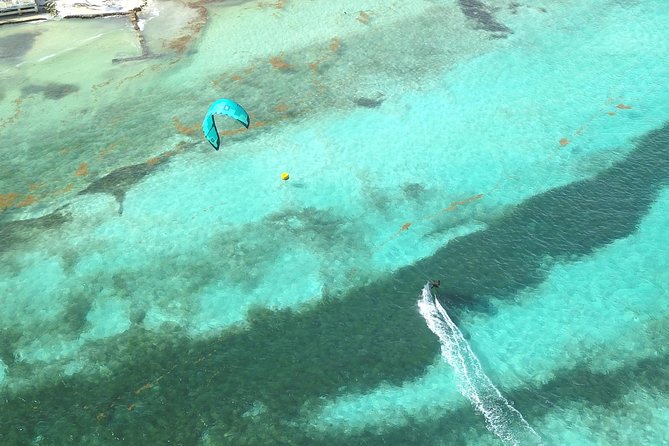
- Max four people per session keeps the lesson personal, not crowded.
- Progression across 1, 2, or 3 days lets you build from wind basics to first waterstarts.
- Real coaching during practice means you’re fixing technique while you’re learning, not later.
- Helmet use included so you can focus on the kite and the board.
- You may train at learner-friendly shallows and then move for better conditions, based on wind and spot choice.
- Instruction team includes Humberto and others such as Marino, Felix, Nelson, and Cuco, depending on the schedule.
A few more Punta Cana trips worth putting side by side with this one:
- Chocolate Master Class & Taino Concept Store★ 5.0 · 43 reviews
- Kiteboarding Lessons in Punta Cana★ 5.0 · 32 reviews
- Punta Cana: Saona Island VIP 4 first-class beach and sunset★ 4.0 · 30 reviews
Punta Cana kiteboarding: why the wind-and-water lesson actually works
Punta Cana is one of the Dominican Republic’s kiteboarding magnets. The reason you’re booking here is simple: you want conditions where you can keep practicing, not just watch someone else ride.
This course is built for progress. You’re not thrown into chaos on day one. Instead, you work through wind theory and kite control in a structured way, then scale up to bigger kites and more technical maneuvers. If you’ve ever tried to learn a technical sport from random videos, you know how frustrating that can be. Here, you get a plan, and you stick to it over the days you choose.
I also like that the school limits the group size. With max four people, the instructor can actually see what your kite is doing and what your body is doing on the water. That matters because in kiteboarding, tiny errors stack fast. One small correction can save a whole session.
Course options: what 1, 2, or 3 days really means
You can pick a 1-, 2-, or 3-day experience, and each day is about three hours of instruction. That matters because kiteboarding isn’t the kind of sport where you learn everything in 90 minutes. You need repeat tries: start, fall, reset, and do it again with better timing.
Here’s how the skill lift works across the days:
- Day 1 is about getting the basics to click: wind, equipment, steering, and learning what control feels like.
- Day 2 shifts to fuller kite control in the water, plus key recovery moves.
- Day 3 moves into more advanced techniques and firsts, like getting up and riding with better direction control.
If you’re a complete beginner, the 2- or 3-day options usually make more sense than a single day. Not because a 1-day course is weak, but because kiteboarding builds in layers. Day 1 gets you moving. Days 2 and 3 help you stop repeating the same mistakes.
Lesson 1: wind theory, the wind window, and trainer kite control
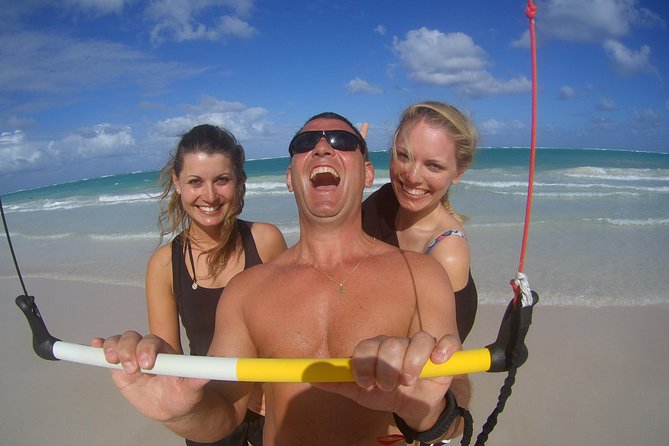
Your day starts at the Kitesurf Academy in Punta Cana, where you meet your instructor and get kitted up. You’ll do a safety briefing first, then head to the beach to begin. This is important. Kiteboarding looks simple on the water, but the safety steps are what keep it from turning into a bad story.
Lesson 1 focuses on the brain part of the sport, then the hands-on part. You start with wind theory and the wind window—basically learning where the kite should sit in relation to you and how that affects power and steering. Then you get hands-on with the equipment so you’re not guessing what lines and controls do.
You’ll train with a trainer kite, which is smaller and designed for learning kite piloting. This is where you practice steering with one hand and feel how the kite responds to your inputs. You’re building muscle memory before you ever commit to full board riding.
Why this is valuable: kiteboarding punishes confusion. If you don’t understand how the wind window works, every attempt to launch can feel like luck. Lesson 1 tries to remove that.





Lesson 2: full-sized kite control, water relaunch, and downwind body dragging
On day two (if you choose the 2- or 3-day option), the pace shifts. You move from trainer kite work to a full-sized kite. That’s a jump, and it’s why this course doesn’t rush you.
The focus becomes control in the water. You practice techniques like water relaunch—the move that helps you get the kite working again when you end up down. You also work on downwind body dragging, which builds strength and familiarity with towing yourself while you learn kite positioning.
This is often the first time people feel that kiteboarders grin moment: the kite catches the wind the right way, and suddenly you’re not just working the controls. You’re moving across the water.
A nice detail from how the school teaches: the instructor feedback tends to be constant. I’ve seen how kite learning improves when you get live corrections, because you can adjust before bad habits lock in.
Lesson 3: upwind bodydragging and your first waterstarts
If you go for the 3-day option, you’ll tackle more complex moves. Lesson 3 is where you start connecting skills in a more real-world way.
You work on upwind bodydragging, a technique used to recover your position and board after you lose the line of travel. You also ride the board in both directions, not just one way. That balance is huge for progressing later, because direction changes are where many beginners get stuck.
Then you attempt your first waterstarts. That’s the moment you go from being pulled to actually popping up and transitioning toward riding. It’s also the part that tends to feel like real progress, even if you’re still learning what “consistent” looks like.
There’s a practical reason for this sequence: you can’t waterstart properly if you haven’t learned kite control and recovery basics first. Lesson 1 and Lesson 2 aren’t just checkpoints. They’re what you’ll use during the waterstart attempts.
The coaching style: why small-group lessons matter on a technical sport
Kiteboarding is technical. It’s not like running or swimming where your body just figures it out. You’re coordinating kite, lines, wind angle, and board movement at the same time. So teaching quality makes a big difference.
This school’s approach is built around instruction you can apply quickly. In practice, that can include radio-based guidance so you can hear adjustments while you’re in the middle of the action. You’re not waiting for the next beach break to be corrected.
The instructors also bring a calm, patient teaching energy. In the Punta Cana sessions, you might work with Humberto or other team members such as Marino, Felix, Nelson, or Cuco, depending on the day and schedule. IKO-style systematic coaching is mentioned in feedback about Humberto, which lines up with how the course is structured: safety first, then wind basics, then controlled practice, then progression.
One more detail that helps: equipment tends to be modern and matched to conditions and student needs. You’ll hear about different kite sizes being used so the setup fits what you’re learning that day.
Where you’ll train: Pearl Beach shallows, Las Salinas-style wind, and spot changes
The course is centered in Punta Cana, but wind can be moody. When kite conditions shift, instructors often adjust spots so you keep getting usable practice.
You may end up training around learner-friendly shallows near Pearl Beach Club, where the water depth is suited to starting and practicing moves without feeling instantly overwhelmed. That’s the kind of environment beginners need for confidence.
When wind is better elsewhere, you might be taken to other well-known kite areas in the region, such as Las Salinas (also known with the Dunes de Bani area). You might also see mention of other spots like Ulvero Alto in longer plans. The main point for you is this: your instruction isn’t locked to one tiny patch of sand. Spot choice can help you learn faster because you practice more consistently.
Potential drawback to be aware of: when conditions change, the day’s plan can feel less predictable than a classroom lesson. Still, if your priority is learning kite skills, spot flexibility is usually a plus, not a hassle.
Gear, safety, and what’s included versus not included
Included is simple and useful: you get a professional guide and helmet use. Everything else that’s part of learning (like kite setup and lesson equipment) is tied to the instruction itself, because the lessons are structured around trainer kite piloting and full-sized kite practice.
What’s not included: food and drinks. This matters because three hours on the water can drain you fast, even if you’re not realizing it. You’ll want to eat and hydrate before you start, and plan to grab food elsewhere since it’s not bundled.
On top of that, the activity is set to operate in all weather conditions. That doesn’t mean you should show up in flip-flops and hope for the best. Dress for actual kiteboarding weather. If it’s hot and windy, you’ll want sun protection. If it’s cooler, you’ll want layers that won’t snag.
You also need a moderate physical fitness level. That’s not about being an athlete. It’s about being able to stay active in the water, handle gear, and keep working technique through falls and resets.
Price and value: is $215.39 per person a smart deal?
The listed price is $215.39 per person, and the experience runs for about three days depending on the option you pick (1, 2, or 3 days). Because the course has different durations, the real value comes from how you match the option to your learning timeline.
Here’s what you’re paying for:
- structured progression (wind basics to waterstarts),
- 3-hour daily instruction,
- small-group limits (max four),
- professional guidance and safety support,
- helmet inclusion.
If you compare this to one-off intro lessons, the value jumps when you pick 2 or 3 days. In kiteboarding, learning is cumulative. One day helps you understand. Two or three helps you start to control the chaos and ride with intent.
If you’re on a short vacation and only want a taste, the 1-day option can still be a good way to decide if kiteboarding is your sport. Just be aware that you’ll likely leave with skills and confidence, not full independence on the water.
Who should book this Punta Cana kiteboarding course?
This experience fits best if you:
- are a complete beginner who wants real instruction without guessing,
- can commit to at least two days if you want meaningful progression,
- prefer a small-group lesson with frequent feedback,
- want a structured approach with wind theory, kite control, and technique practice.
It also works if you’ve kited before and want targeted coaching. Some instructors in the school’s orbit are described as able to handle both new learners and more advanced instruction, including more complex maneuvers. The core value is still the same: you practice with corrections that help you improve.
Should you book Kiteology DR’s kiteboarding lessons?
If your goal is to learn kiteboarding the right way, this is a strong booking choice. The combination of small-group size, a clear progression across 1–3 days, and hands-on coaching makes it easier to improve without wasting time.
I’d only hesitate if:
- you hate the idea of making your own way to the meeting point (unless you selected a pickup option),
- you’re not comfortable with moderate physical activity on the water,
- you’re expecting a casual try-it-once experience rather than skill-building.
If you want to leave Punta Cana with more than photos and wind stories, booking the 2- or 3-day option is the smartest move.
FAQ
Where is the kiteboarding lesson located?
The lessons are in Punta Cana, Dominican Republic, with the start listed in La Altagracia Province.
How long are the lessons each day?
Each day includes a 3-hour class.
Can I choose a 1-, 2-, or 3-day experience?
Yes. You can choose a 1-, 2-, or 3-day experience.
Do I need any previous kiteboarding experience?
No. The experience is suitable for complete beginners.
How big is the group?
The maximum group size is four travelers.
What’s included in the price?
The included items are a professional guide and use of a helmet.
What’s not included?
Food and drinks are not included, and hotel pickup and drop-off is not included unless you select the option that offers it.
Does the lesson run in bad weather?
The activity operates in all weather conditions. If it’s canceled due to poor weather, you’ll be offered a different date or a full refund.
What should I wear or bring?
You should dress appropriately for conditions since it operates in all weather. Helmet use is included.
Is free cancellation available?
Yes. You can cancel for a full refund up to 24 hours in advance of the experience start time.
More Workshops in Punta Cana
- Group Surf Lessons Punta Cana – Fun, Easy & Beginner-Friendly
★ 4.5 · 121 reviews - Chocolate Master Class & Taino Concept Store
★ 5.0 · 43 reviews - Punta Cana: Saona Island VIP 4 first-class beach and sunset
★ 4.0 · 30 reviews - Punta Cana: One-on-One Surf Lesson on Macao Beach
★ 4.6 · 26 reviews - Chocolate Master Class & Taino concept Store
★ 4.6 · 12 reviews - Full-Day Surf Camp in Punta Cana –Lessons, Beach Time & Adventure
★ 5.0 · 12 reviews
More Tour Reviews in Punta Cana
- Private Airport Punta Cana to La Romana Bayahibe or Casa de Campo Resort Area
★ 5.0 · 6,662 reviews - Punta Cana Zipline Adventure with Buggies and Horseback Riding
★ 5.0 · 5,001 reviews - Full-Day Santo Domingo City Tour from Punta Cana
★ 4.5 · 4,500 reviews - Punta Cana: Catamaran Boat to Saona Island with Buffet Lunch
★ 4.4 · 3,822 reviews - Punta Cana Dune Buggy Adventure and Amazing Water Cave
★ 4.5 · 3,411 reviews - Half-Day Adventure 4×4 ATV, Water Cave and Dominican Culture
★ 4.5 · 3,394 reviews
Fresh off the boat: the newest Punta Cana reviews




Workshops, compared.
 ★ 4.5Group Surf Lessons Punta Cana – Fun, Easy & Beginner-FriendlyFrom $115121 reviews
 ★ 5.0Chocolate Master Class & Taino Concept StoreFrom $5743 reviews
 ★ 4.0Saona Island VIP 4 first-class beach and sunsetFrom $12530 reviews
 ★ 4.6One-on-One Surf Lesson on Macao BeachFrom $11526 reviews
★ 4.6Chocolate Master Class & Taino concept StoreFrom $5712 reviews
★ 4.6One-on-One Surf Lesson on Macao BeachFrom $11526 reviews
★ 4.6Chocolate Master Class & Taino concept StoreFrom $5712 reviews
 ★ 5.0Full-Day Surf Camp in Punta Cana –Lessons, Beach Time & AdventureFrom $20012 reviews
 ★ 4.7‘Chillo al Coco’ Cooking Class & Taino Concept storeFrom $9810 reviews
 ★ 5.0Dance Bachata/salsa like a PRO with private classFrom $457 reviews
Browse the lists this tour appears in